Experiences and curiosities · A history of taste
Marsala, time in a glass
From the family barrel to English merchant ships and great reserves: the story of a Sicilian wine worth understanding before buying.
A story by Francesco Caputo · 15 November 2026
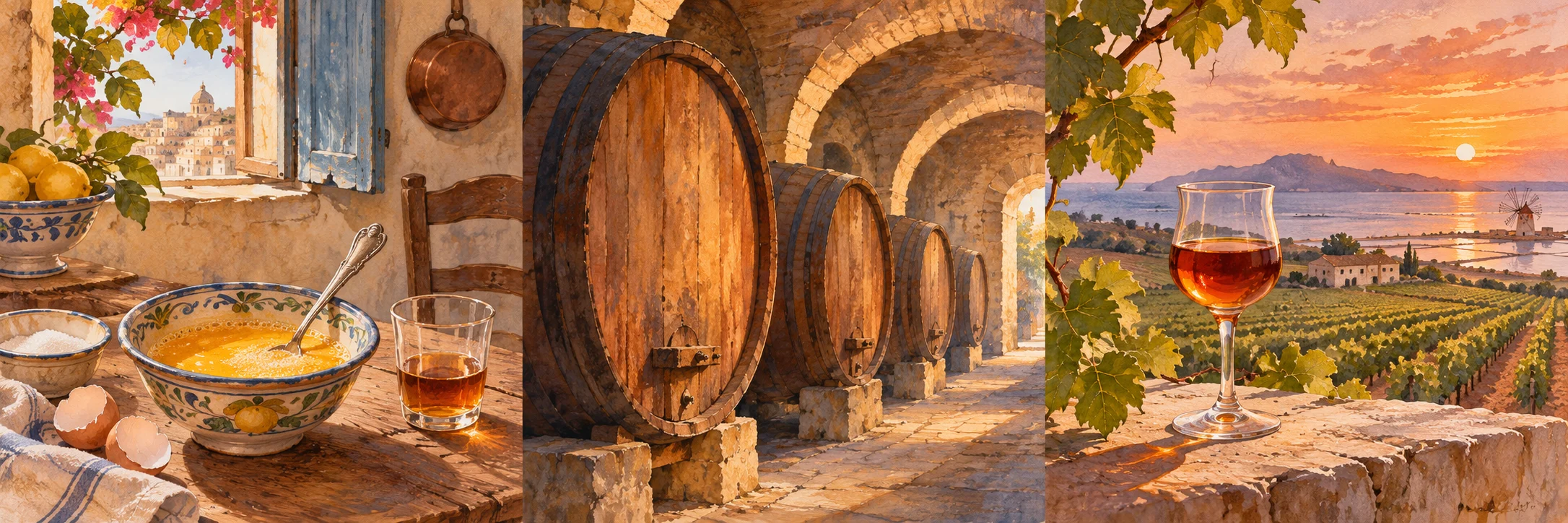
For me, this story begins with a teaspoon. My grandmother would beat an egg yolk with sugar and, on festive days, add a splash of Marsala. As a Sicilian, she knew that little touch well. It was something precious, saved for special occasions. Today, while looking for a good bottle, one price stopped me: 44 francs for half a litre. That prompted a question: how do we get from the family barrel to a bottle that can cost 119 francs?
Before the famous name, the barrel
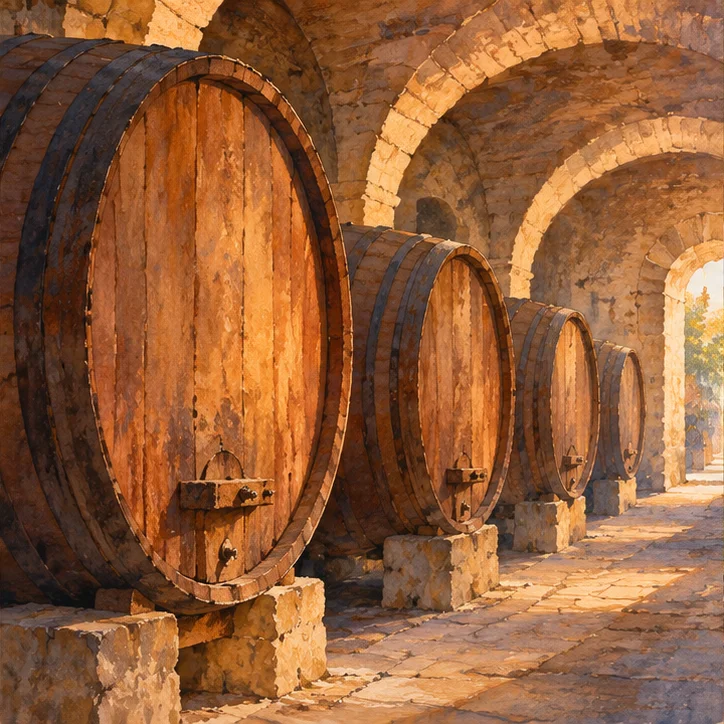
Before modern Marsala came the wines of the Marsala countryside, some kept for many years in wood. The perpetuo tradition involved drawing off part of the wine and replacing it with younger wine. Different harvests thus remained connected in the same vessel: the wine kept living, without starting from scratch each year. These are authentic farming and family roots, but that wine was not necessarily the sweet Marsala many people picture today. 1
1773: a Sicilian wine takes to the sea
The date traditionally associated with the turning point is 1773. English merchant John Woodhouse tastes the local wine, recognises its potential and ships some to England, adding grape spirit to make it more stable on the voyage. The story of the storm that supposedly brought him to Marsala belongs to tradition: it should be distinguished from the better-documented commercial developments. The local wine meets a market that already appreciates Port, Madeira and Sherry. 2, 3
How grapes become Marsala
First, a base wine is made; fortification with alcohol of vinous origin or wine spirit and ageing follow. Depending on the type, preparation may also include sifone, meaning grape must with added alcohol, and cooked must. Vergine follows the path of wine and alcohol, without these additions of must. Wood, oxygen and time then accompany its evolution. Not all Marsala wines are sweet, nor do they all have the same colour or character. 4
1833: Florio and a wider world
After Woodhouse, other British entrepreneurs, including Ingham and Whitaker, develop the trade. In 1833, Vincenzo Florio establishes his own winery between the English premises. Large facilities, sales networks and shipments follow: Marsala wins prestige as early as the nineteenth century. Its history is therefore more than that of a household wine that has become expensive today; it is also the story of a long-established international enterprise. 2
When quantity overshadows character
During the twentieth century, part of production turns towards large volumes and less ambitious quality. The Marsala name becomes increasingly associated with cooking or a generic sweet wine. This image overshadows the finest bottles. Yet the story remains diverse: different producers and wines cannot all be judged in the same way. 1, 5
Returning to the roots with Marco De Bartoli
In the late 1970s, Marco De Bartoli begins his own journey at the family baglio, a traditional rural estate, in Samperi. In 1980, he introduces Vecchio Samperi, reviving perpetuo without added alcohol: precisely because of this characteristic, it cannot be called Marsala. In 1985, Vigna La Miccia is born instead, a more delicate, fruitier semidry Marsala Oro, in which excessive oxidation is limited. Two different wines express two ways of engaging with the same land. 1, 6
What are we paying for when we pay for time?
A Superiore ages for at least 2 years, a Superiore Riserva for at least 4, a Vergine for at least 5 and a Vergine Riserva for at least 10. These are minimums: some reserves remain in the cellar much longer. 7 In economic terms, care, labour, space, evaporation and tied-up capital can explain part of the price. Rarity, reputation, distribution and margins also contribute. This is a general economic interpretation, not an audit of any individual winery’s costs.
119 francs: a question, not a guarantee
A bottle priced at 119 francs may have a history of long ageing and small quantities, but the price alone does not prove it. We need to know which wine it is, how much the bottle holds, how it was aged and who is selling it. In the comparison on 15 November 2026, 50 cl Vigna La Miccia was listed at CHF 44 by Smith & Smith and CHF 29.50 by Vinacria, with the latter not specifying the vintage and delivery charged separately. 8, 9 These are shop prices, subject to change: they are not absolute measures of quality.
This is what I look for: a bottle with something to tell and a price that can be explained. My grandmother’s festive splash and a great reserve can belong to the same story. Respect for tradition also includes the right to ask questions. Francesco Caputo · Le Tavole Vere del Mondo
← Back to Experiences and curiosities